
Cumulative Impacts and Coastal Changes
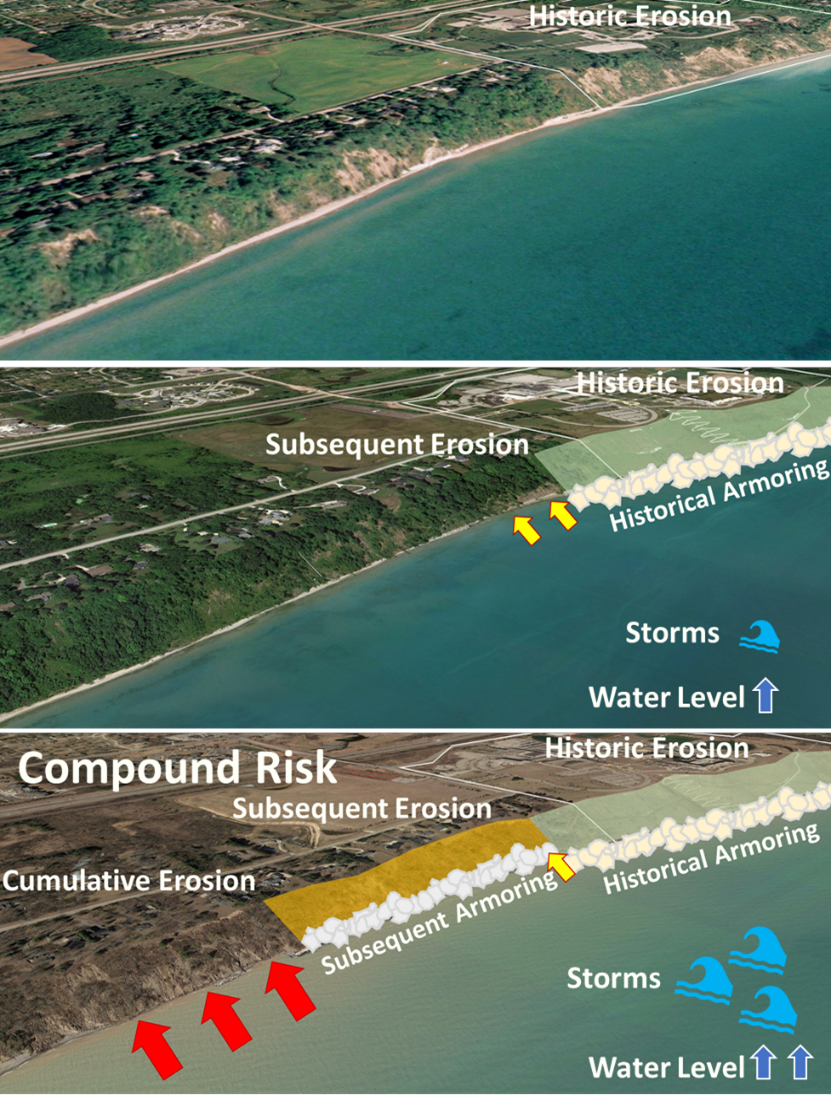 The
cumulative impacts of coastal erosion are influenced by a cascade
of drivers compounding in space and time that have physical,
social, and community ramifications. Risk to coastal communities
caused by increasingly intense physical changes threaten people,
their livelihoods, and environmental health. Coastal erosion costs
the U.S. over $500 million in damages, over $150 million in
infrastructure and over 80,000 acres of wetlands every year.
In the Great Lakes, fluctuating water levels and more intense
storms have created a physical environment that appears to be
consuming the shoreline. Erosion of coastal assets such as bluffs
and dunes can be observed at the bottom (toe) up to the top
(crest), often nearby human infrastructure, namely people's homes.
The current practice to defend against this perceived threat is
armoring the shore with conventional building materials, which
have been shown to adversely affect neighboring properties. The
cumulative impacts of these structures under fluctuating water
levels and more intense storm waves have yet to be quantified.
Additionally, indirect risks – such as elevated erosion occurring
on properties adjacent to coastal structures – associated with
coastal bluff erosion have not been comprehensively characterized.
Furthermore, the role of local and global decision-makers has not
been integrated with an analysis of the physical drivers to
coastal erosion. These gaps in knowledge pose social, economic and
environmental challenges that fuel community conflict, incur heavy
costs, and jeopardize local and regional ecosystems.
The
cumulative impacts of coastal erosion are influenced by a cascade
of drivers compounding in space and time that have physical,
social, and community ramifications. Risk to coastal communities
caused by increasingly intense physical changes threaten people,
their livelihoods, and environmental health. Coastal erosion costs
the U.S. over $500 million in damages, over $150 million in
infrastructure and over 80,000 acres of wetlands every year.
In the Great Lakes, fluctuating water levels and more intense
storms have created a physical environment that appears to be
consuming the shoreline. Erosion of coastal assets such as bluffs
and dunes can be observed at the bottom (toe) up to the top
(crest), often nearby human infrastructure, namely people's homes.
The current practice to defend against this perceived threat is
armoring the shore with conventional building materials, which
have been shown to adversely affect neighboring properties. The
cumulative impacts of these structures under fluctuating water
levels and more intense storm waves have yet to be quantified.
Additionally, indirect risks – such as elevated erosion occurring
on properties adjacent to coastal structures – associated with
coastal bluff erosion have not been comprehensively characterized.
Furthermore, the role of local and global decision-makers has not
been integrated with an analysis of the physical drivers to
coastal erosion. These gaps in knowledge pose social, economic and
environmental challenges that fuel community conflict, incur heavy
costs, and jeopardize local and regional ecosystems.
A resilient coast tackles these gaps through a transdisciplinary
approach of characterizing and responding to the compound risks
linked to cumulative coastal erosion. Sustainable shore protection with Nature-Based Coastal
Solutions integrated with the human dimension is a missing link in
traditional coastal management practice. Southeastern Wisconsin
experiences accelerated rates of bluff erosion under historically
high-water levels and increased levels of human-development. As
bluffs become less stable, the need for comprehensive sustainable
shore protection that addresses the cumulative impacts of coastal
erosion becomes more pressing.